

Residents called Shoreline police less and the police responded faster to 911 calls, cut more traffic tickets, and closed more cases. The Sheriff contract keeps costs low, said the 2025 Shoreline police services report reviewed by the city council at the April 13, meeting.
Fewer Calls and Faster Responses
Each year, Shoreline residents call the police less often; the police received 16,567 calls in 2018 but that number fell to 13,971 in 2025, according to the report.
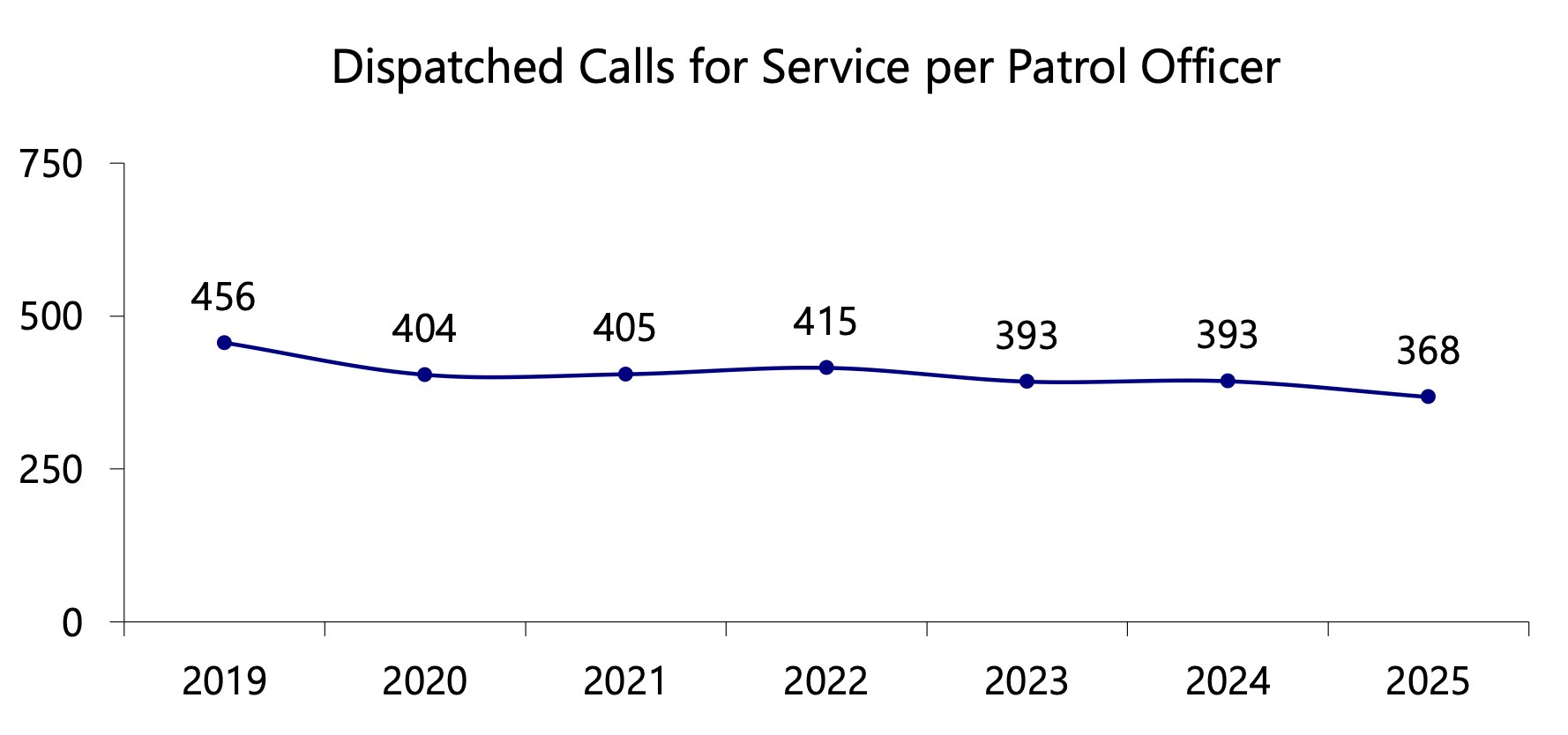
Even though the police department still has 9 vacancies, the average number of dispatch calls for service (DCFS) per patrol officer has declined each year, down from 456 in 2019, reaching 368 calls per officer in 2025, said to the report.
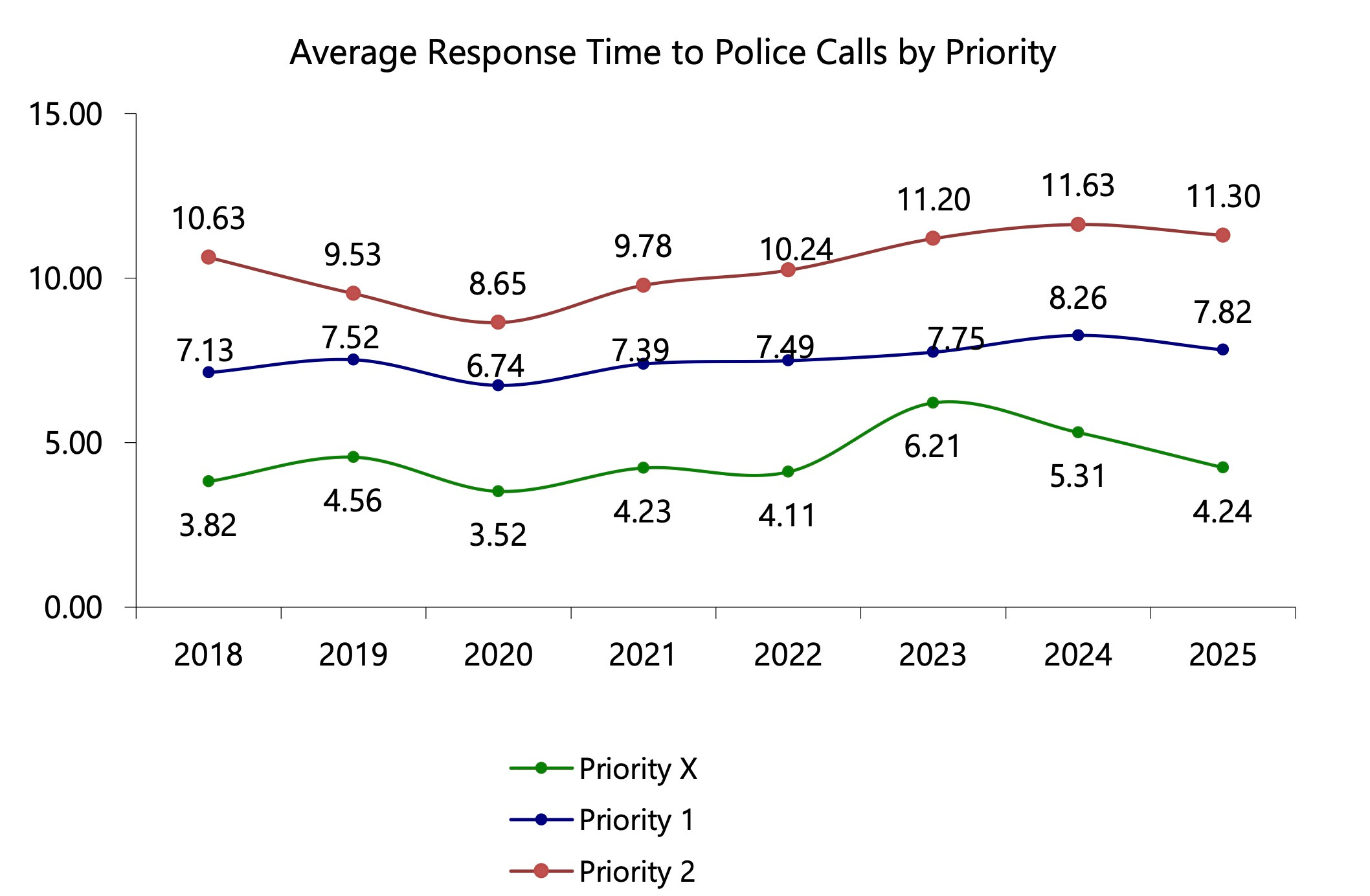
With fewer calls, the average police response times to the highest priority 911 calls continued to improve, according to the 2025 report.
In 2023, the police department told the city council that average 911 call response times for the highest priority calls had skyrocketed from 4.11 minutes to 6.21 minutes, in part because of staffing shortages.
But since then, average high priority 911 response times have improved each year: dropping to 5.31 minutes in 2024 and 4.24 minutes in 2025 (comparable to pre-pandemic numbers).
Ongoing Staffing Challenges
Like other cities, Shoreline continues to struggle to hire and retain police officers.
After pandemic-era mass resignations, the Shoreline police department ended 2022 with 13 out of 50 commissioned officer positions empty (a 26% vacancy rate) according to the 2022 Police Service Report.
By the end of 2023, the police department reported 9 out of 50 commissioned officer positions vacant and again reported 9 out of 50 positions vacant at the end of 2024.
The most recent report says the police department ended 2025 again with 9 commissioned vacancies.
Shoreline’s police staffing shortages are not unusual. In 2024, the King County Sheriff reported 66 vacancies out of a total of 793 positions, an improvement from 2023 when there were 107 total vacancies.
More Closed Cases and Traffic Tickets
With fewer calls, the Shoreline police department closed more cases, despite staffing shortages.
In 2020, the number of cases closed by Shoreline police worsened to 665, falling from 961 in 2019. The police reported low cases closed numbers from 2020 through 2023. But in 2024, the number of cases closed by the Shoreline police improved to 902, and last year, the police closed 1,126 cases in 2025 according to the police report.
The department’s Special Emphasis Team has been restaffed, resulting in an increase in the number of illegal drug cases, prostitution-related offenses, and weapon law violations the police investigated in 2025 according to the report.
Police issued more traffic tickets but still fewer than pre-pandemic levels.
Because of staffing shortages, the Shoreline police traffic unit was redeployed to cover high-priority 911 calls. According to data compiled from previous annual reports, prior to 2020, Shoreline’s traffic unit typically issued an average of more than 5,800 traffic citations per year. After the traffic unit was redeployed, that number dropped to 217 citations in 2023.
The police traffic department hired one deputy in the summer of 2024, and traffic citations rose to 1,261 in 2025.
Regional Crisis Response (RCR) Agency
Unlike Seattle’s police department, Shoreline dispatches behavioral health crisis responders alongside police in response to some 911 calls.
Established in 2023 in a partnership between Shoreline, Lake Forest Park, Kenmore, Bothell, and Kirkland, the North King County’s Region Crisis Response (RCR) agency provides de-escalation and behavioral health services to people in crisis alongside police officers.
In 2025, RCR cared for 562 people in crisis in Shoreline during 1,122 encounters ranging from multi-hour crisis de-escalations to short follow-up check-ins to ensure someone has been connected to care, according to the police report.
Low Costs Through Economies of Scale
Like Kenmore and Woodinville, the city of Shoreline contracts with the King County Sheriff’s Office (KCSO) for law enforcement services; police wear uniforms and drive cars that say “Shoreline Police Department”, but they are employees of the KCSO.
According to the police report, the city’s KCSO contact keeps costs down through “economies of scale” and “has been an effective way to provide quality law enforcement services and contain costs.”
The police report said Shoreline’s per capita KCSO contact cost was $252 in 2024 and $264 for 2025.
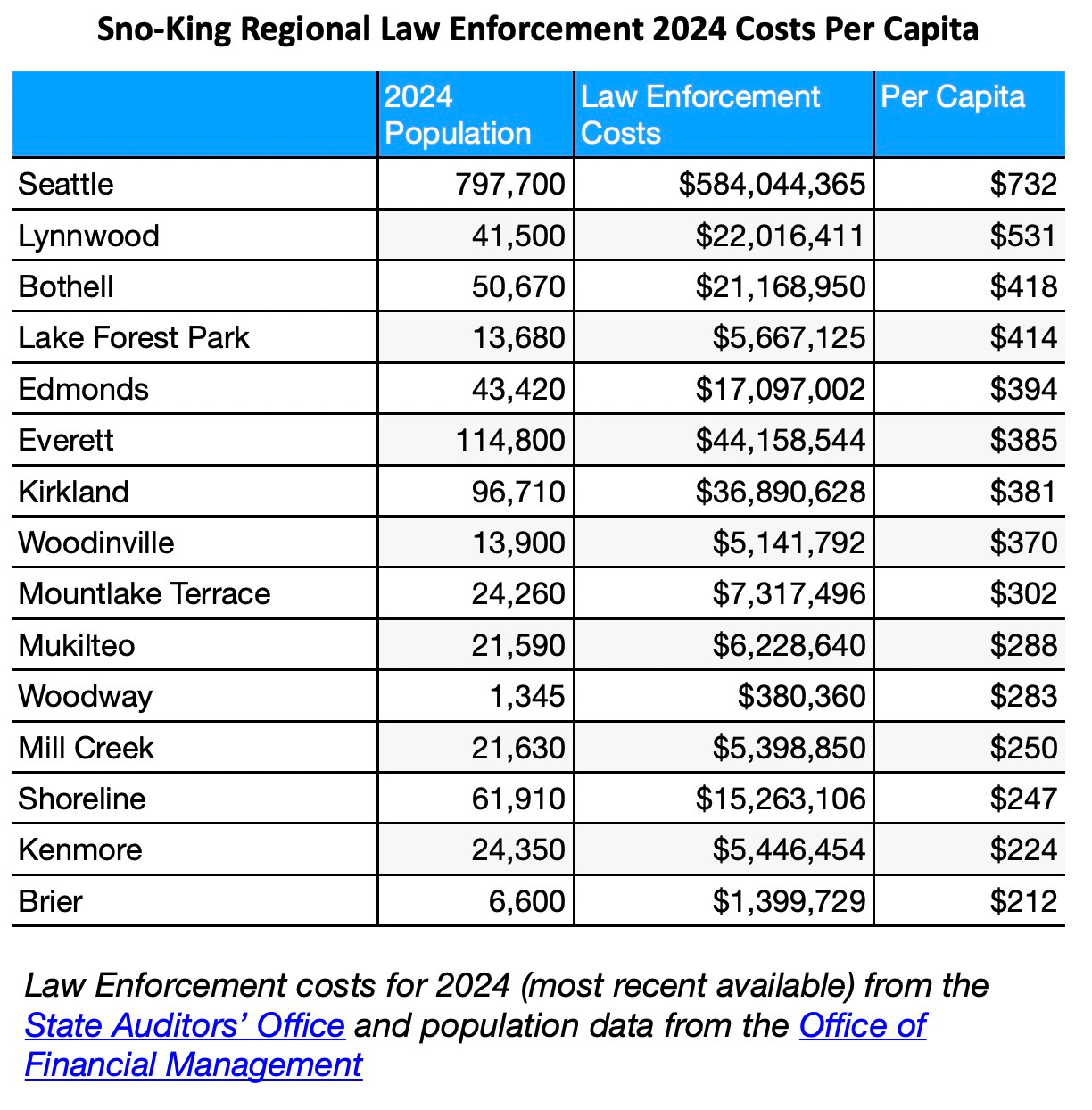
Although police costs have increased, Shoreline pays less compared to neighboring cities for law enforcement. Law Enforcement costs vary widely around North King County and South Snohomish County according to data from the State Auditors Office (SAO) Financial Intelligence Tool and official population estimates from the Office of Financial Management (OFM) for 2024 (the most recent year data was available).
In 2024, Seattle spent $732 per capita on law enforcement activities, Lynnwood spent $531 per capita, Bothell spent $418, Lake Forest Park spent $414, and Edmonds spent $394 per capita, according to data from the SAO and OFM.
In contrast, Mill Creek spent $250, Shoreline spent $247, Kenmore spent $224, and Brier spent $212 per capita on law enforcement activities in 2024 according to data from the SAO and OFM.
Per capita 2024 Law Enforcement costs:
Seattle: $732
Lynnwood: $531
Bothell: $418
Lake Forest Park: $414
Edmonds: $394
Everett: $385
Kirkland: $381
Woodinville: $370
Mountlake Terrace: $302
Mukilteo: $288
Woodway: $283
Mill Creek: $250
Shoreline: $247
Kenmore: $224
Brier: $212
For some historic context, here's the 2017 Shoreline police services report which shows the Dispatch Calls For Service Per Patrol Officer was lower in 2025 than any year since 2013. https://www.shorelinewa.gov/home/showpublisheddocument/38793/636615432846430000